Oculis Learner Hub is built to the shape of the programme you already run — not the other way round.
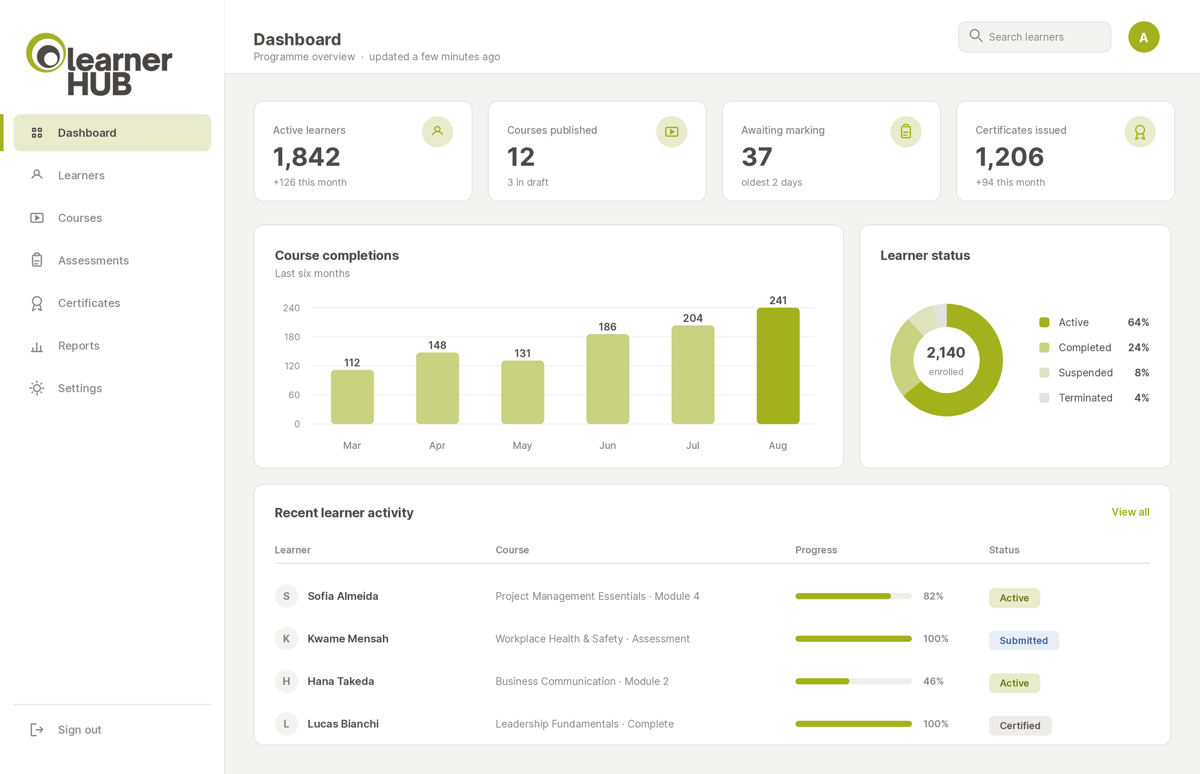
Illustrative interface. Data shown is for demonstration.
We're paying for a full LMS and using half of it
Our learners are logging into three different places
We had to change our process to fit the system
We asked the vendor for that and never heard back
Every LMS on the market assumes the learning happens inside it, and assumes you want everything it offers. Organisations that don't match that assumption end up either paying for a large system they use a fraction of, or running a programme the software cannot hold together. Both end the same way — the platform gets worked around instead of worked in.
Learner Hub was not designed as a product and then sold. Both times it was built, a real programme could not be served by anything available.
A professional development pathway combining licensed university content, live instructor-led cohorts and on-demand practice. Three providers, three platforms.
Learners navigated between them with nothing joining the journey together. No LMS solves that, because none are built to hand a learner out and take them back. So we built the layer that holds the pathway together.
An institutional client going through that pathway asked whether we could give them a lighter version of the LMS they were already paying for.
They were using a fraction of its features and carrying the weight of the rest. We built them the version they actually needed — smaller, not bigger.
Two clients, opposite problems, the same root cause: neither could buy what they needed.
A training operation that needs eight things does not benefit from being sold eighty. The extra seventy-two are what make a system too heavy to actually use.
Learner Hub is multi-tenant. That is the mechanism, not the pitch — it is what lets each client have a platform fitted to their programme without paying to have one built from scratch.
Each tenant's data is isolated at the database level and enforced by row-level security, so one client's users cannot reach another's data even if the application misbehaves.
Tenants run on a subdomain by default, or point their own domain at their tenant — learn.yourcompany.com — so learners stay inside your brand throughout.
Training operations are almost always run by one person. If enrolling an intake means typing learners in one at a time, that person goes back to spreadsheets — which is why the last system failed.
Learner Hub powers SkillsPro360 — a live programme combining licensed university content, live instructor-led cohorts and on-demand practice into one learner journey.
That is the thing no off-the-shelf LMS is built to do: enrol a learner, hold their record and cohort, hand them off to an external platform, and receive them back with progress intact.
Learner Hub is not a content marketplace. We do not author your courses and we have no catalogue of off-the-shelf content to sell you.
We build the platform around your programme. The programme stays yours.
A guided demo, walked through with the shape of your own training operation in mind.
Book a demo